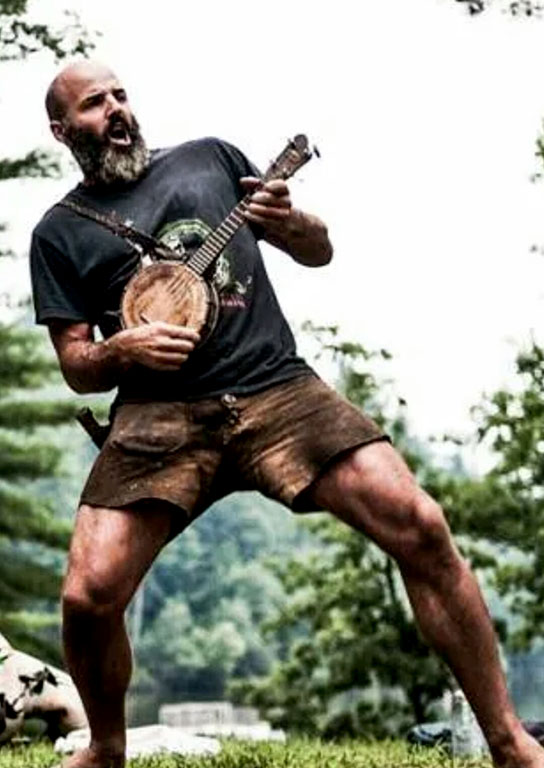
Tod Kershaw…
Owner/ Operator of Baby Eggbert’s
Ironworks
Baby Eggbert’s Ironworks is an off grid metal and woodworking establishment in the mountains of western North Carolina, not far from Asheville. The type of blacksmithing I do I call Neo Pre-Post-Apocalyptic Blacksmithing and the woodworking I refer to as Crapentry.
Baby Eggbert is our little stillborn baby who now sleeps in a lovely spot just outside our door. His full, funny, in-the-womb name was Eggbert Muffin Warf-Kershaw Esquire III. But that is too long a name for a workshop.
My wife and I live off grid in a tiny home that she built and the workshop, we built with the help of friends, is just across the stream from the house.
I worked for many years as a welder and briefly in an industrial steel foundry and I always enjoyed the metal working, but I did not like the toxicity of the materials or the monstrous energy use. When I was in my early 40’s, after quitting engineering because cubicle living is not for me, I went to a primitive and homesteading skills rendezvous and discovered blacksmithing and that was that. Interestingly, just before he died, my father told me that he had taken me to a craft fair in Louisiana when I was very young and that I hung around the blacksmith all day. I have no memory of that.
One of my earliest memories – from before the craft fair – is of seeing a dumpster full of toys (at least that’s all I saw in the dumpster) in the courtyard of the military housing complex we lived in at Fort Leavenworth Kansas. I hopped right in and took everything I wanted. Don’t know how much of it mom let me keep. And I have continued scavenging other people’s trash my entire life.
When I first decided to start blacksmithing, I was adamant that I would make my own forge and bellows from as much local material as possible and without power tools. This decision set me back temporally because I had so much to learn before I could start building anything. But eventually I made a forge out of stone and clay from the land I was living on in Madison County, NC. The only metal was the air pipe, which I retroactively installed after my clay pipe leaked too much air, causing me to have to work the bellows really hard, which tired out my arms.
The bellows were based on bellows that a friend of mine had seen in use while traveling in Africa. I modified the design to suit my purposes. I used leather that I had hand tanned from deer hides and all raw wood from the forest. I was determined not to use any metal fasteners, which seems silly for blacksmithing bellows, but I wanted to learn the techniques. The bellows were beautiful and functional and received much praise and I used them for several years and my shoulders still hurt from pumping them! They have been retired and replaced with a professionally manufactured antique hand cranked blower.
Blacksmithing is a valuable and useful craft that can be done almost for free monetarily – almost everything can be scavenged. Scavenging, for me, is rewarding work even though it means more time spent to accomplish what could be done quicker with the expenditure of more money.
Many basic tools can be gotten for free or really cheap. Hammers without handles I find at scrap yards and flea markets and junk piles and abandoned houses. And I make the handles with hickory, ash or white oak from the forest around me. Usually I try to find a downed tree instead of cutting one down.
So much steel gets thrown away that I rarely buy steel even at scrap yards. Rebar, my favorite material for making tongs, I can find in dumpsters at construction sites. I have pulled old farm machinery out of stream banks and fields. Often I’ll see some delicious scrap, like an old tractor pulled hay rake – which has both mild steel or wrought iron if it’s old enough, and spring steel for knife making in the tines – in a field. And I ask for it and usually get it. For free.
The forge I most often use I made from a steel 55 gallon drum. I have 2 forges that I use for teaching away from home or for demonstrating. One is an approximately 100 year old rivet forge that I obtained in a trade. The other I made, without the use of power tools, from an automotive brake rotor, some tube steel from a scrap yard and sheet metal cut out of a 55 gallon drum.
When I first started blacksmithing, I made all my charcoal in a charcoal maker that I made, or I scavenged it from campfires or from the woodstove in the winter, and sifted out the ashes. I was determined not to buy coal. Then I discovered that, after all the trees had been cut down, people in this area heated their homes with coal. Then they went to wood, when the trees grew back or to heating oil, natural gas or propane. The coal piles were abandoned. But coal does not expire – it’s already hundreds of millions of years old and is basically not effected by weather. So I have found probably around 5 or 6 tons of coal in the last few years. I share it with friends and burn it in my forge. It’s not blacksmithing coal – but it is free and it burns nicely. I have learned so much more about coal fires in general than if I was buying coal that’s processed for blacksmithing. It makes forge welding a bit more of a challenge, but it’s free and plentiful and someday I’ll figure it out. At one event I taught at for a few years in Kentucky, there was a coal seam on the property and I would bust chunks of coal out of the ground and run the forge with it!
My personal goal is to learn as much as I can about the craft of blacksmithing from a Neo Pre-Post-Apocalyptic perspective and to share my learning and excitement with anyone who wants it.
 Baby Eggbert's Ironworks